REAL LIFE by Amrita Mahale

A haunting meditation on love, erasure, and what it means to exist authentically in a world that is always watching.
Set against the stark, unflinching beauty of the Himalayas, Real Life begins as a disappearance mystery and slowly unfolds into something far more profound. Tara, a wildlife biologist studying dholes in the remote Mahamaya Valley, has vanished. Her best friend Mansi retraces her steps. Bhaskar, the prime suspect, sits in custody, his testimony a web of obsession and contradictions. But this is not merely a whodunit. It is an excavation: of memory, guilt, friendship, power, and the quiet ways women disappear.
From the very first page, the prose grips you with unsettling tenderness. As seen in the opening chapter, the narrative begins with a chilling image: “There aren’t many young women who disappear like that and then return.” The tone is stark, intimate, almost accusatory; immediately situating the reader inside grief and inevitability.
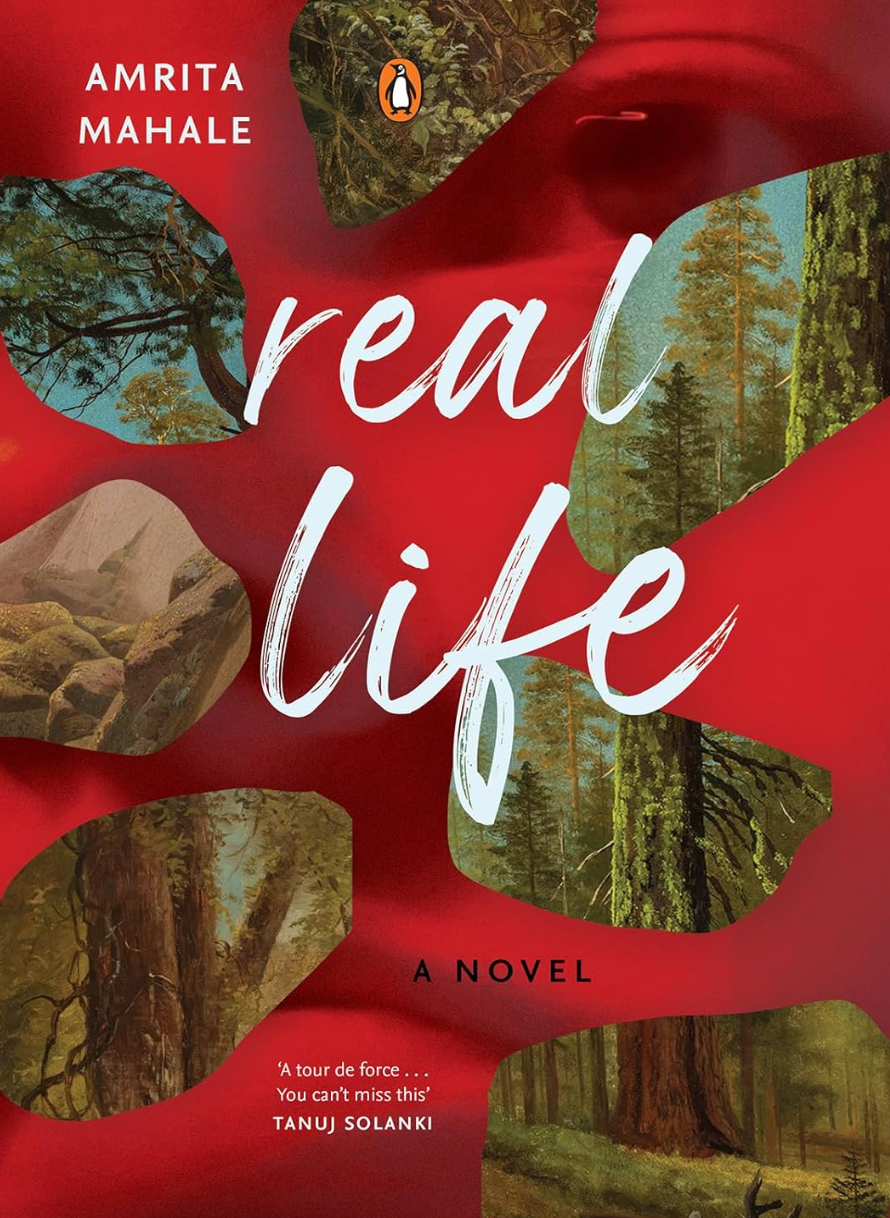
The novel is structured in three parts —Mansi, Bhaskar, and Tara— each voice distinct, layered, and emotionally charged. Through these shifting perspectives, we witness how relationships are shaped not just by love, but by insecurity, power, silence, and longing. The same valley looks different depending on who is seeing it. The Himalayas are not just landscape; they are psychological terrain , expansive yet isolating, majestic yet indifferent.
Mansi’s voice carries nostalgia and regret. Her recollections of childhood friendship are tender, almost luminous. When she describes meeting Tara as children; the fierce little girl grieving for a dog injured by cruelty; we see how empathy and guilt shape both girls’ identities.
The intimacy of their bond feels deeper than romance- symbiotic, formative, life-defining.
Bhaskar’s narrative, in contrast, unsettles. As an AI engineer navigating patriarchal conditioning and social awkwardness, his perspective explores male entitlement, loneliness, and obsession in disturbing yet disturbingly human ways. The novel does not caricature him; it dissects him. And in doing so, it interrogates how societal scripts shape male desire and female vulnerability.
But it is Tara’s voice that lingers longest. Fierce, reflective, and unafraid to question herself, Tara embodies the novel’s central tension: what does it mean to live a “real” life? In a world of surveillance, conformity, and endless digital noise, can authenticity survive? The book’s premise itself asks: “In an age of surveillance and enforced conformity, what does it mean for a woman to seek a more authentic, real existence?”
Mahale’s writing is poetic without being indulgent. Consider the image of stars mistaken for bullet holes in the dark; a metaphor that collapses beauty and violence into one frame. Or the recurring idea of forgetting versus remembering, that forgetting may bring happiness, but real life demands confrontation.
Themes of female friendship, environmental consciousness, caste, feminism, surveillance, individuality, and societal control are woven seamlessly into the narrative. Nothing feels forced. Everything feels earned.
The open ending is deliberate and deeply effective. Rather than closure, Mahale offers reflection. Rather than answers, she offers questions. The mystery resolves emotionally more than factually, and that is precisely the point.
Real Life is not just about a woman who disappears. It is about the many subtle ways women are erased: by lovers, by society, by expectation, by silence, and sometimes by themselves. It is about guilt carried like a second skin. About obsession disguised as love. About memory as both burden and anchor.
This is a novel you finish, and then continue to live with.
For readers who value layered storytelling, psychological depth, feminist inquiry, and writing that is as sharp as mountain air, Real Life is essential reading.
Book Dragon Verdict: 5 / 5
Unputdownable. Unsettling. Unforgettable.
A novel that does not just tell a story; it holds up a mirror.


Comments